How Many Hours of SAT Prep Does It Actually Take to Raise Your Score?

Wondering how much time you need to invest in SAT prep to see real results? The answer depends on where you’re starting and how much you want to improve — but there’s clear data to guide you. Here’s what you need to know before you begin.
It’s one of the first questions students and parents ask when they start thinking about SAT prep: “How long is this going to take?” And it’s a fair question. Between school, extracurriculars, and everything else competing for your time, you need a realistic picture of what SAT preparation actually requires.
The short answer is: it depends. But the longer answer is far more useful — because once you understand the factors that drive score improvement, you can build a prep plan that is efficient, targeted, and actually works.
What the Research Shows About SAT Prep Hours
The College Board, which administers the SAT, has published general guidelines on the relationship between study hours and score improvement. While individual results vary, the pattern is consistent: more focused prep time correlates with larger score gains, up to a point.
Here is a general framework based on score improvement goals:
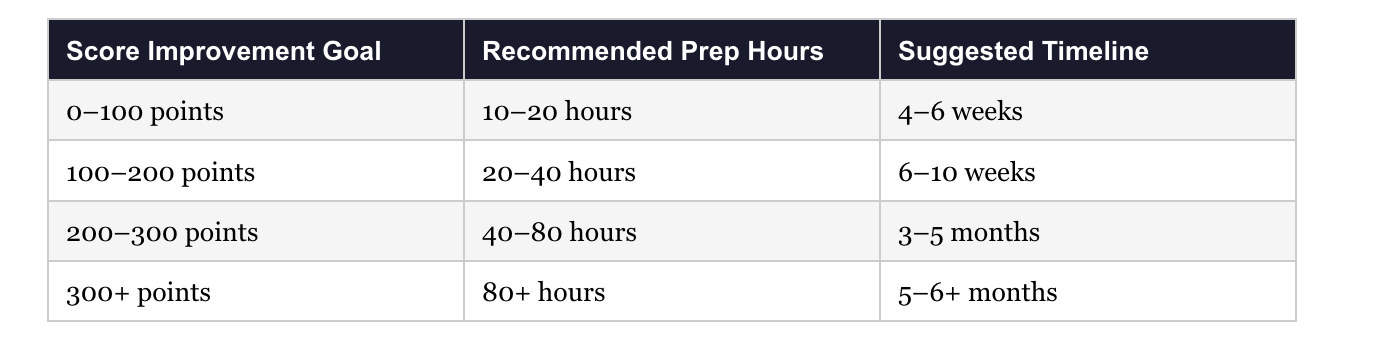
These are starting points, not guarantees. The quality and structure of your preparation matters just as much as the raw number of hours you log.
Why Hours Alone Don’t Tell the Whole Story
Twenty hours of unfocused review is not the same as twenty hours of targeted, strategic practice. Students who see the biggest score gains aren’t necessarily the ones who study the longest — they’re the ones who study the most effectively. Here’s what separates productive prep from time spent going through the motions:
Diagnostic-first preparation. Before you study anything, take a full-length practice test under timed conditions. Your results will show you exactly which question types and content areas are costing you the most points. That diagnostic is your roadmap — without it, you’re studying in the dark.
Deliberate error review. The most important thing you can do after any practice set is not move on — it’s understand every mistake you made. Why did you get it wrong? Was it a content gap, a misread, a careless error, or a time pressure issue? Each type of mistake requires a different fix.
Spaced repetition, not cramming. Studying for three hours every day for two weeks before the test is far less effective than spreading that same time across three or four months. Your brain retains information better when it has time to consolidate between sessions. Consistency beats intensity.
How Your Starting Score Affects Your Prep Plan
Where you’re starting on the SAT scale changes what prep looks like significantly.
If you’re scoring below 1000:
There is a lot of opportunity for improvement, but it will require building foundational skills. Students in this range often have content gaps in core math concepts or reading comprehension strategies that need to be addressed before test-taking tactics will stick. Budget more time — and be patient. The gains will come.
If you’re scoring between 1000 and 1200:
This range often yields the most dramatic improvements with structured prep, because students typically have solid underlying skills but inconsistent test-taking strategies. Targeted work on timing, question patterns, and common traps can produce score jumps of 100 to 200 points in a matter of weeks.
If you’re scoring above 1300:
Gains become harder to achieve at the higher end of the scale — but they’re still possible. Students aiming for 1400+ need to focus on eliminating careless errors and mastering the specific question types that appear in the upper difficulty range. Precision matters more than volume at this stage.
How to Structure Your SAT Prep Time for Maximum Impact
Whether you have six weeks or six months, the structure of your prep matters as much as the duration. A well-organized plan generally moves through three phases:
Phase 1 — Diagnose and learn. Take a diagnostic test, identify your weakest areas, and focus your study sessions on building those specific skills. This phase is about content mastery, not speed.
Phase 2 — Practice and refine. Take timed section-by-section practice, review every error carefully, and start developing test-taking strategies for your weakest question types. Retake full practice tests every few weeks to track progress and adjust your focus.
Phase 3 — Simulate and sharpen. In the final two to three weeks before test day, shift to full-length timed practice tests taken under real test conditions. The goal here is stamina, timing, and mental sharpness — not new content.
When Should You Start Prepping for the SAT?
The best time to start SAT prep is earlier than most students think. Ideally, students should begin a structured prep program at least three to six months before their target test date. This allows enough time to move through all three phases without cramming, and leaves room for a retake if needed.
Many students in Connecticut and across the country take the SAT for the first time in the spring of their junior year, with a second attempt in the fall of senior year. That timeline gives you a full summer between attempts — a valuable window for focused preparation.
The students who see the most meaningful score gains are not always the ones who studied the most hours. They’re the ones who started early, stayed consistent, and worked with a clear plan. That combination — time, structure, and targeted effort — is what actually moves the needle.
Ready to build a personalized SAT prep plan?
At Spark Your College Story, our one-on-one SAT prep sessions are built around your diagnostic results, your target score, and your schedule. We don’t use a one-size-fits-all curriculum — because your path to a higher score is uniquely yours. Book a free consultation today and let’s map it out together.